Canine IVDD & Spinal Rehabilitation
Structured physiotherapy for dogs with IVDD and other spinal conditions — supporting recovery after surgery or supporting with conservative management. Not just supporting the dogs but the owners. Physio is crucial in starting with correct posture to support the spine.
What is IVDD?
Spinal conditions are among the most common neurological problems seen in dogs, and Intervertebral Disc Disease is the most frequently diagnosed of them. They affect mobility, coordination, strength and quality of life — but with early intervention and structured physiotherapy, many dogs make remarkable recoveries.
IVDD occurs when the cushioning discs between the vertebrae degenerate, bulge or rupture into the spinal canal. Those discs normally act as shock absorbers. When they fail, pressure is placed on the spinal cord or nerve roots — causing pain, weakness and sometimes paralysis.
Sudden, explosive rupture
Common in chondrodystrophic breeds such as Dachshunds and French Bulldogs. Acute, severe symptoms that often appear over hours.
Slow, chronic bulge
Seen more often in larger breeds, with a gradual onset of weakness that can be mistaken for age or stiffness.
IVDD is graded I–V by severity of neurological signs
The grade shapes both the treatment route and the realistic outlook — it's the first thing I'll want to know from your vet.
Pain only
No weakness or loss of coordination. The dog remains fully mobile but may be reluctant to move.
Mild weakness
Slight stumbling or a wobbly gait. The dog is still able to walk unaided.
Moderate paresis
The dog can move the limbs but cannot support weight or walk without help.
Paralysis, deep pain present
Complete inability to walk. Deep pain sensation is still present — a positive prognostic sign.
Paralysis, no deep pain
The most severe grade. Early intensive treatment is critical.
How Physiotherapy Helps
Physiotherapy is central to IVDD recovery — supporting conservative management and post-operative rehabilitation alike. A structured programme addresses every consequence of spinal cord injury: pain, muscle loss, coordination deficits and reduced mobility.
The overarching aim is to promote neuroplasticity — the nervous system's ability to reorganise, rebuild damaged pathways and form new connections — while systematically restoring the strength and movement needed for a good quality of life.
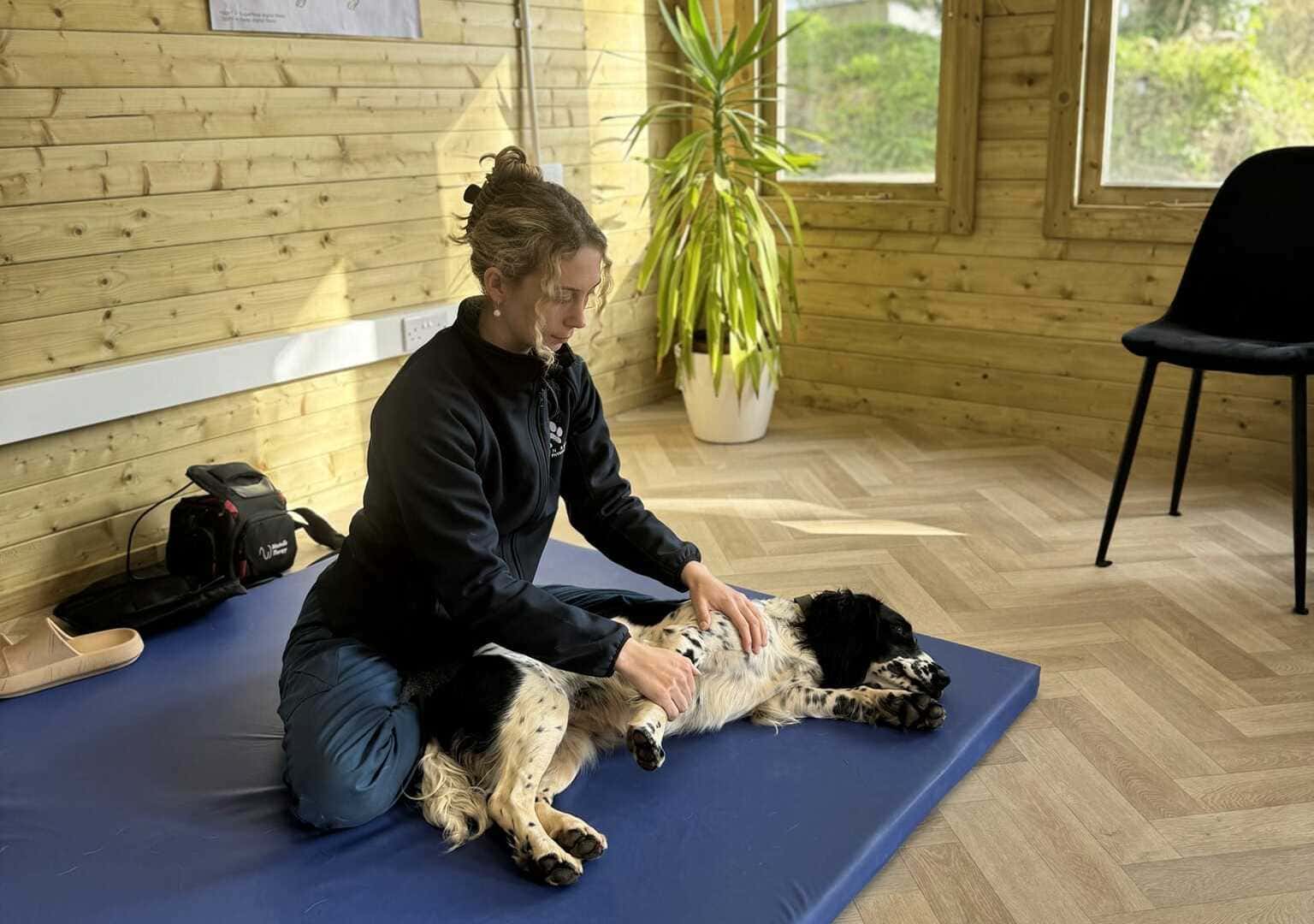
Assessment first. Posture, gait, reflexes and muscle condition tell me what the spinal cord is and isn't doing — and give us a baseline to measure everything against.
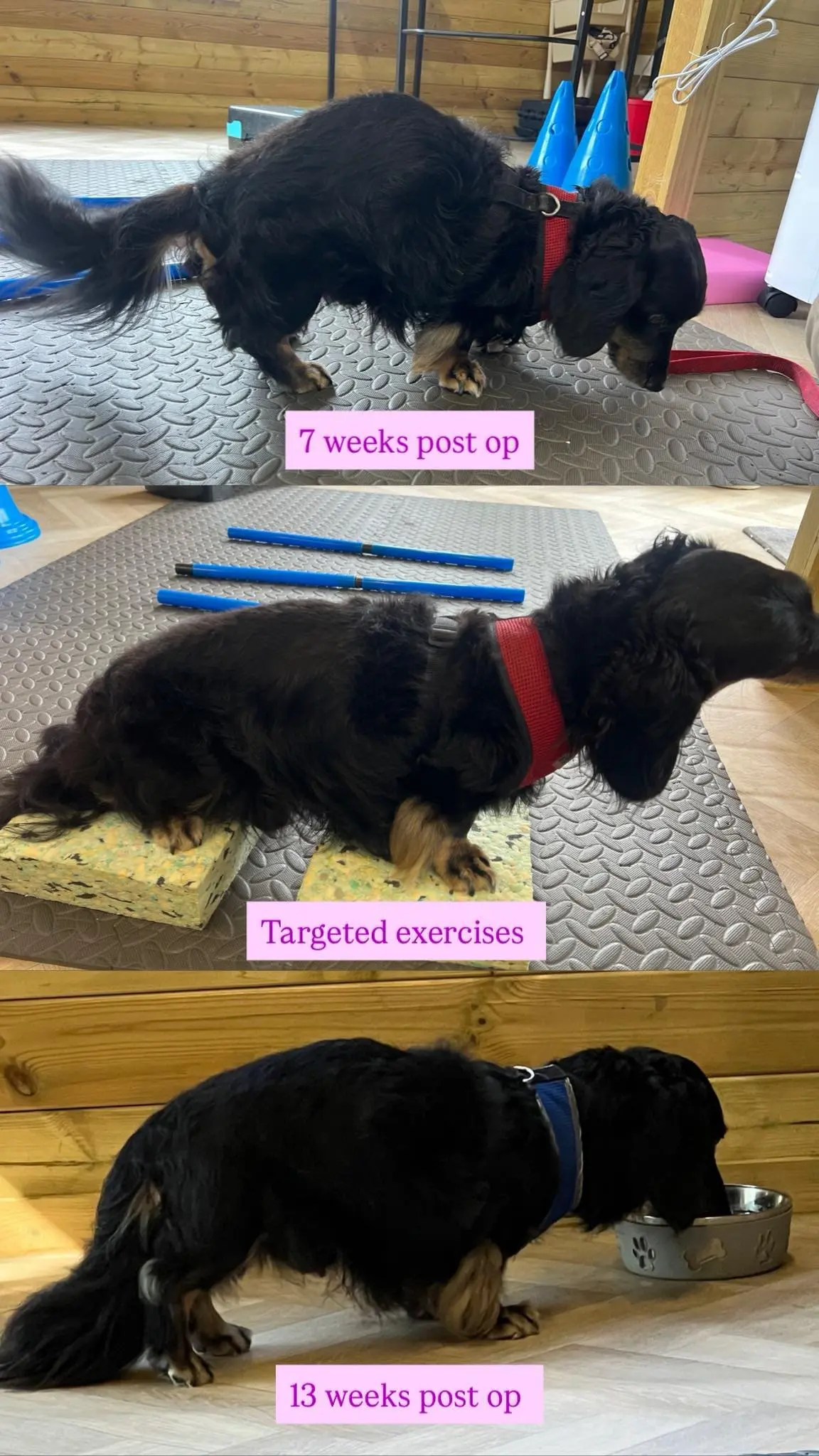
Then the work. Hands-on treatment, supported standing and weight shifting, progressed session by session at whatever pace the dog can take.
Why Early Physio Matters
- Stimulates neuroplasticity — helping the nervous system form new connections around the injury
- Prevents rapid muscle atrophy in both the affected and compensating limbs
- Manages pain naturally, reducing dependence on long-term medication
- Restores proprioception and balance for safer, more confident movement
- Supports bladder and bowel function recovery where the spinal cord is involved
- Reduces the risk of complications such as pressure sores and joint contracture
- Works alongside both conservative management and post-operative recovery
- Leaves you with the knowledge and exercises to support recovery at home
What I Do in Sessions
⚡ Electrotherapy — TENS & NMES
🔴 Laser Therapy (Photobiomodulation)
🤲 Manual Therapy & Massage
🔵 Proprioception & Balance Training
🏋️ Progressive Strengthening
🏠 Home Exercise Programme
A Typical Recovery Journey
Assessment & Foundation
Full neurological assessment, pain management, passive range of motion, and early nervous system stimulation. Two to three sessions per week.
Active Rehabilitation
Active exercises introduced, along with balance and proprioception work and progressive strengthening tailored to each dog's response.
Functional Recovery
Gait retraining, advanced functional exercises, and a gradual return to normal activities, with ongoing monitoring and programme refinement.
Maintenance & Prevention
Home exercise programme, lifestyle and weight advice, and long-term support to reduce the risk of recurrence.
What IVDD Does to Posture
Dogs with spinal pain or neurological dysfunction often change the way they hold themselves and move. These compensatory patterns can tell us a lot about where a dog is struggling.
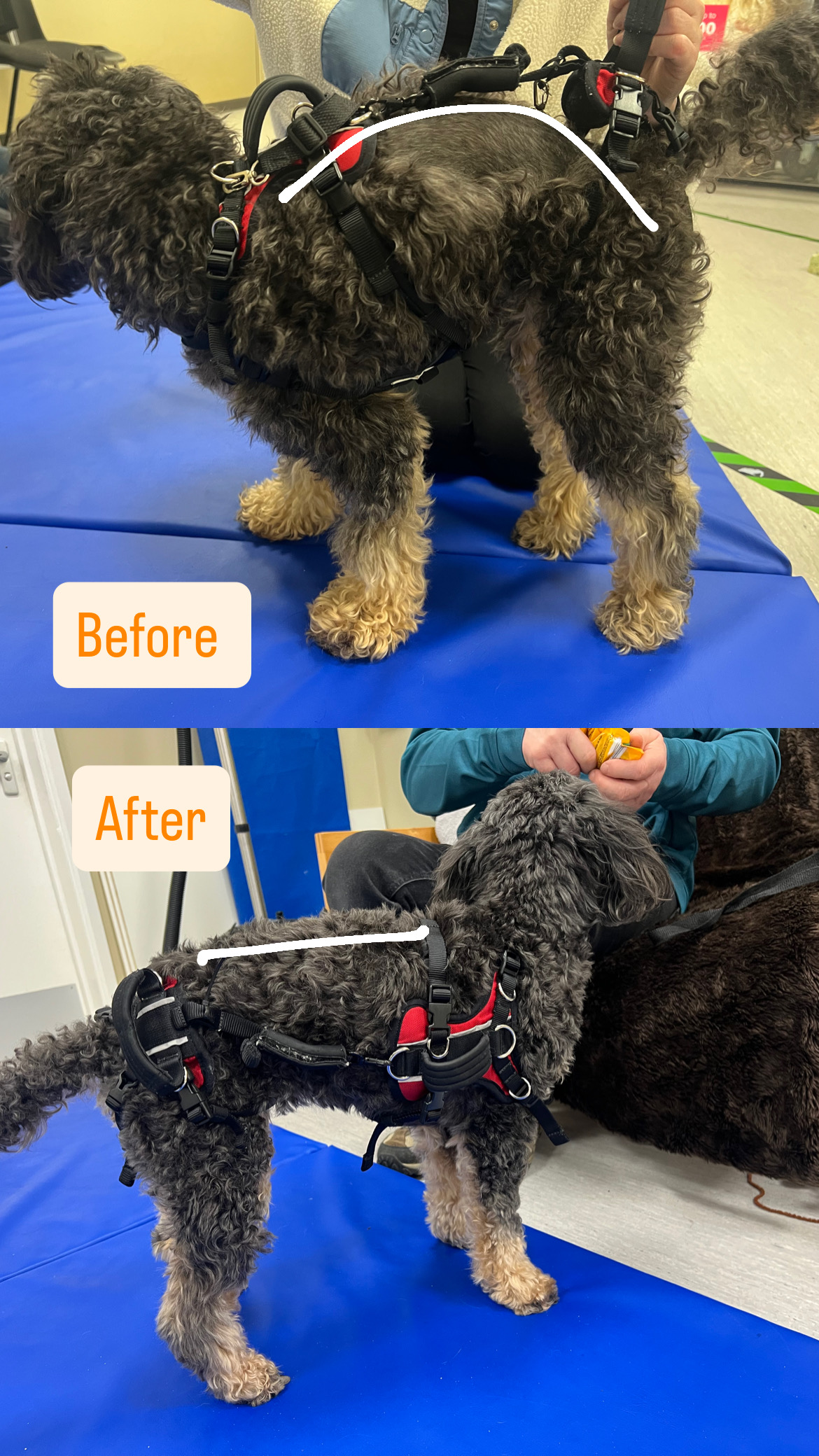
A lowered head and neck, rounded or kyphotic spine, increased muscular tension through the back and changes in hindlimb posture can all be seen in dogs with spinal conditions.
Physiotherapy assessment looks at these whole-body changes rather than focusing only on the location of the disc problem.

Common IVDD posture changes. Lowered head and neck, a kyphotic arch through the spine, increased muscular tension over the back, and reduced muscle through the hindquarters.
Which dogs are most at risk?
Chondrodystrophic breeds — those with abnormally short limbs due to differences in cartilage development — are genetically predisposed, and their discs calcify earlier in life. That said, any dog can develop IVDD.
Other Conditions I Can Help With
Alongside IVDD I work with dogs diagnosed with a range of other spinal and neurological conditions. Each needs a tailored approach — but all benefit significantly from structured physiotherapy.
Fibrocartilaginous Embolism (FCE)
Fibrocartilage from a disc enters the blood supply to the spinal cord, causing sudden loss of function. Typically non-painful after the initial event. Physio is central to neurological recovery — many dogs improve significantly with intensive rehabilitation.
ANNPE
Acute Non-Compressive Nucleus Pulposus Extrusion — a high-velocity disc extrusion causing sudden, often severe neurological signs without ongoing compression. Managed conservatively, which makes physiotherapy the primary treatment driving recovery.
Degenerative Lumbosacral Stenosis
Also called cauda equina syndrome. Compression of the nerve roots in the lower back, causing hindlimb weakness, pain on rising, reluctance to jump and sometimes tail or bladder dysfunction. Physio supports pain management and strengthening alongside medical or surgical treatment.
Spondylosis Deformans
A degenerative condition where bony bridges form along the spine, typically causing stiffness and reduced mobility rather than neurological deficits. Manual therapy, targeted strengthening and laser therapy are particularly effective here.
Degenerative Myelopathy (DM)
A progressive, non-painful spinal cord disease causing gradual hindlimb weakness and eventually paralysis — most common in German Shepherds, Corgis and Boxers. There is no cure, but physiotherapy slows progression and keeps dogs mobile for longer.
Other Neurological Conditions
Not sure what your dog has been diagnosed with? If your vet has identified a spinal or neurological condition affecting mobility, strength or coordination, physiotherapy can almost certainly help. Get in touch and we'll talk through what's possible.
Early physiotherapy makes a difference
For conditions like FCE and ANNPE, where there is no ongoing compression, physiotherapy is often the primary treatment driving recovery. For progressive conditions like DM, starting rehabilitation early — before significant muscle loss occurs — gives the best chance of maintaining quality of life for longer. Don't wait to see if things improve on their own.
Warning Signs of IVDD
IVDD can come on suddenly — particularly Type I — or worsen gradually over weeks. Early intervention is one of the most important factors in how well a dog recovers.
Pain & Sensitivity
Yelping when touched or picked up, flinching, hunched posture, or visible tension through the back and neck. Your dog may resist turning their head or lowering their nose to the ground.
Wobbly or Uncoordinated Gait
Stumbling, crossing the legs when walking, or appearing drunk. This ataxia is caused by disrupted signals between the spinal cord and the limbs, affecting balance and coordination.
Weakness or Paralysis
Reduced ability or complete inability to bear weight on one or more limbs. The hind limbs are most commonly affected. Some dogs drag their back legs or knuckle over on their paws.
Bladder & Bowel Changes
Difficulty urinating, dribbling urine, or incontinence. Straining to defecate or loss of bowel control — signs that the nerves controlling these functions are being compressed.
Reluctance to Move
Refusing stairs or jumping, hesitation when rising from rest, morning stiffness, or unwillingness to do exercise that was previously enjoyed.
Behavioural Changes
Unusual lethargy, loss of appetite, changed temperament, or seeming generally not themselves. Chronic pain is often expressed as personality change rather than obvious distress.
What the Research Shows
The case for early, structured physiotherapy in IVDD recovery is well supported by peer-reviewed research. The evidence consistently shows that rehabilitation improves neurological outcomes compared with rest alone.
Faster Return to Walking
Dogs receiving intensive physiotherapy after IVDD surgery regain the ability to walk significantly faster than those managed with rest alone — particularly in Grades III and IV.
Neuroplasticity & Axonal Regrowth
Targeted sensorimotor stimulation promotes axonal sprouting and synaptic reorganisation in the injured spinal cord. Early movement is now understood as a key driver of neurological recovery, not just a consequence of it.
Preventing Muscle Loss
Dogs with IVDD lose significant muscle mass within weeks without rehabilitation. Electrotherapy combined with active and passive exercise substantially reduces this neurogenic atrophy.
Conservative Management Success
For Grades I–II, physiotherapy-supported conservative management achieves outcomes comparable to surgery in many cases. Structured intensive rehab is the key — cage rest alone produces significantly worse results.
Reducing Recurrence Risk
Core strengthening and ongoing body condition management are associated with reduced risk of future disc events. Dogs who complete a full rehabilitation programme show improved long-term spinal stability.
Laser Therapy Evidence
Multiple studies confirm that photobiomodulation reduces neuroinflammation, promotes axonal regeneration and enhances myelination. Neuroprotective effects are strongest when treatment begins in the acute phase.
IVDD Recovery Case Studies
Real dogs I've worked with. Each one started in a very different place, and each made progress that surprised even their owners. Names used with permission.
🐾 Toffee
The Problem
Toffee became paralysed due to a disc extrusion in her neck. She had ventral slot decompression surgery and came to me with just some movement in her front limbs — unable to walk or stand.
The Approach
Intensive rehabilitation over several weeks, building on small improvements session by session. Every tiny gain was used as a foundation for the next stage of recovery.
Outcome
Toffee is now a completely normal dog — walking, running, living life. You wouldn't know she was ever paralysed. Early, consistent rehabilitation gives the best chance of neurological recovery.
🐾 Rosie
The Problem
Rosie lost all movement and sensation in her hind legs following a severe L3/L4 disc extrusion requiring emergency spinal surgery. She had also had IVDD surgery in 2023.
The Approach
Carefully structured physiotherapy focusing on posture correction, neurological re-education, strength building and coordination — with consistent home exercise work.
Outcome
Rosie progressed from complete hind limb paralysis to walking independently again. Recovery after spinal surgery is rarely linear — but consistent rehab, patience and commitment can completely change the outcome.
🐾 Dexter — IVDD Spinal Surgery Recovery
The Problem
Dexter began physiotherapy seven weeks after spinal surgery for IVDD. He was still dependent on a sling, had significant hind limb weakness, and a noticeable roach in his back.
The Treatment
Targeted physiotherapy, sling adaptations, and adjunct radiofrequency therapy. Dexter made steady progress with a structured rehab plan built around his abilities at each stage.
Rehab Focus
Outcome
Dexter now walks independently with a stronger, more coordinated gait. You can really see the difference in his back — the before and after speaks for itself. A fantastic example of teamwork and structured rehab after IVDD surgery.
These are three of the dogs I've worked with. Every recovery looks different — but early, consistent physiotherapy makes the difference.
The Rehabilitation Package
A structured, evidence-based intensive programme designed to give your dog the best possible chance of neurological improvement and functional recovery.
Intervertebral Disc Disease & Neurological Conditions
Ten sessions, a tailored neurological plan, and support between appointments.
What's Included
- 1 × Initial Physiotherapy Consultation (£60 value)
- 9 × Follow-Up Treatment Sessions (£50 each)
- Tailored neurological rehabilitation plan
- Progressive mobility & strengthening programme
- Ongoing progress monitoring & reassessment
- Home exercise programme with clear guidance
- Direct communication between sessions
Recommended Schedule
- 2–3 sessions per week for the first 2 weeks
- Then weekly sessions as recovery progresses
- Frequency adjusted as strength & coordination improve
- Flexible scheduling around your dog's needs
Start Rehabilitation as Early as You Can
Early, consistent therapy gives the best chance of neurological improvement and functional recovery. The sooner rehabilitation begins after diagnosis or surgery, the greater the potential for a meaningful outcome.
Helping animals move better, recover faster, and live their best life.
BUSINESS


SERVICES
SERVICE AREAS
OPERATING HOURS
Sun: Closed
Mon: 9:00am - 5:00pm
Tue: 9:00am - 5:00pm
Wed: 9:00am - 5:00pm
Thu: 9:00am - 5:00pm
Fri: 9:00am - 5:00pm
Sat: Closed
Privacy Policy | Term & Condition | FAQ
Copyright © 2026 Kirsten Vet Physio. All rights reserved.