Canine Hip Dysplasia Rehabilitation
Veterinary physiotherapy in Cornwall for dogs with hip dysplasia — building the muscle that supports the joint, easing pain, and keeping dogs comfortable and active for as long as possible.
What is Hip Dysplasia?
Hip dysplasia is a developmental condition in which the hip joint doesn't form as it should. The hip is a ball and socket joint, and the head of the femur sits inside the socket of the pelvis. In a healthy hip the two fit together snugly. In a dysplastic hip the fit is loose, so the joint moves in ways it isn't built to.
That looseness — joint laxity — is where the problem starts. Every step grinds the ball against the rim of the socket rather than rotating cleanly within it. The body responds by remodelling the bone and laying down new tissue, and over time the joint surfaces wear. This is why hip dysplasia and osteoarthritis go hand in hand.
Many factors can condtribute to hip dysplasia.
Dogs typically present at one of two stages: as young dogs between roughly five and twelve months, when laxity and inflammation cause pain in an otherwise healthy joint; or as older dogs, when secondary arthritis in a long-standing dysplastic hip finally becomes symptomatic.
Joint Laxity
The femoral head sits loosely in the socket, allowing abnormal movement and repeated trauma to the joint surfaces with every stride.
Shallow Socket
The acetabulum fails to deepen normally, so the joint has less bony coverage and depends far more on surrounding muscle for stability.
Inflammation & Pain
Repeated abnormal loading inflames the joint capsule and cartilage — the source of pain in young dogs before arthritis has developed.
Secondary Arthritis
Cartilage wears, new bone forms around the joint margins, and the hip stiffens. This is what limits most dogs in later life.
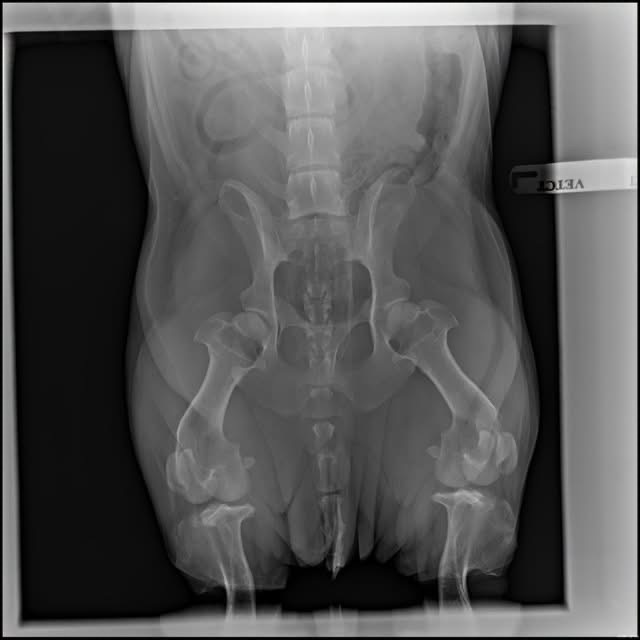
Ventrodorsal pelvic radiograph. This is the view your vet uses to assess the hips, how deep each socket is, how well the femoral head sits inside it, and whether new bone has started forming around the joint margins. Diagnosis and grading are done by your vet; my role begins once you have that picture.
Hip Dysplasia can be managed surgically and conservatively penidng on how bad it is
Surgical options exist and are the right call for some dogs. But some are managed conservatively and managed well, most live full, active, comfortable lives.
Conservative management rests on four things: keeping weight down, getting exercise right, building and maintaining muscle around the joint, and controlling pain. Physiotherapy is directly involved in three of the four, and I'll help you with the fourth.
Signs of Hip Dysplasia
Signs are often subtle and easy to put down to age or personality. Dogs are good at hiding hip pain, they compensate long before they limp.
Bunny-Hopping
Running with both back legs moving together rather than alternating. The classic sign, it lets the dog avoid loading one painful hip at a time.
Difficulty Rising
Slow or laboured to get up after rest, especially first thing or after a long sleep. Often looser once they've been moving for a few minutes.
Reluctance With Stairs & Jumping
Hesitating at steps, refusing to jump into the car, or needing a run up where they used to hop straight in.
Loss of Hindquarter Muscle
Thighs and glutes look thin or wasted while shoulders and chest look overdeveloped, the dog has shifted weight forward off the hips.
Narrow or Swaying Stance
Back feet placed close together, hips rolling side to side when walking, or the back end looking unsteady on turns and slippery floors.
Doing Less
Shorter walks, lying down mid walk, less interest in play, more time asleep. Frequently mistaken for a dog simply slowing down with age.
How Physiotherapy Helps
I can't change the shape of the joint. What I can change is how much support it gets, how the dog loads it, and how much pain and stiffness they carry as a result, and that is most of what determines quality of life.
🏋️ Targeted Strengthening
🤲 Manual Therapy & Joint Mobilisation
🔵 Gait & Proprioception Retraining
🔴 Laser Therapy & Electrotherapy
📏 Weight & Exercise Management
🏠 Home Exercise Programme
Why Physio Makes a Difference
- Builds the muscle that a shallow hip joint depends on for stability
- Reduces pain and stiffness without relying solely on medication
- Slows arthritis progression by improving how the joint is loaded
- Corrects compensations before they cause back and shoulder problems
- Keeps older dogs steady, confident and on their feet for longer
- Gives young dogs the best possible start with a lifelong condition
- Supports recovery and maximises the outcome if surgery is needed
- Gives you a clear plan you can actually follow at home
A Typical Management Journey
Initial Assessment
Full gait analysis, joint and muscle assessment, muscle condition scoring, and a review of your vet's findings and imaging. A plan built around your dog's grade, age and lifestyle.
Weeks 1–4 — Comfort
Pain and inflammation management, gentle range of movement, laser therapy, exercise restructured, and the first strengthening work introduced. Home programme starts on day one.
Weeks 4–12 — Building
Progressive hindquarter strengthening, proprioceptive retraining, gait correction and a controlled increase in exercise, with regular reassessment of comfort and muscle.
Ongoing — Maintenance
A long-term plan with periodic check-ins, home exercise maintenance, weight monitoring and lifestyle advice to protect the joint as your dog ages.
What the Research Shows
Conservative management of canine hip dysplasia is well supported. The recurring theme across the evidence is that weight, muscle and controlled exercise do most of the work.
Body Weight Is the Biggest Lever
Long-term studies in Labradors found that dogs kept lean throughout life developed hip osteoarthritis later and less severely than their littermates fed freely — and lived significantly longer. Weight control is the single most effective intervention available to owners.
Muscle Stabilises the Joint
Strong periarticular musculature reduces functional laxity and peak loading through the joint surfaces. Maintaining hindquarter muscle mass is consistently associated with better function and comfort in dysplastic dogs.
Controlled Exercise Beats Rest
Prolonged rest causes muscle loss, which worsens joint instability. Regular, controlled, low-impact exercise maintains muscle and range of movement without the joint trauma of high-impact activity.
Compensation Causes Secondary Problems
Dogs with painful hips reliably develop compensatory strain through the lumbar spine, and overload the forelimbs. These secondary problems are a major source of long-term discomfort — and are largely preventable.
Laser Reduces Joint Inflammation
Photobiomodulation has been shown to reduce inflammation and support pain relief in osteoarthritic joints, and is increasingly used as an evidence-based adjunct alongside exercise-based rehabilitation.
Physio Improves Surgical Outcomes
Where surgery is needed, dogs receiving structured post-operative rehabilitation regain limb function faster and show better long-term gait symmetry than those managed with rest alone.
The Rehabilitation Package
A structured, evidence-based programme for dogs with hip dysplasia — whether managed conservatively or recovering from surgery.
Hip Dysplasia, Elbow Dysplasia, TPLO & Orthopaedic Conditions
Six sessions, a tailored plan, and support between appointments.
What's Included
- 1 × Initial Physiotherapy Consultation (£60 value)
- 5 × Follow-Up Treatment Sessions (£50 each)
- Tailored conservative or post-surgical rehab plan
- Targeted strengthening & movement correction programme
- Laser therapy or electrotherapy included in sessions
- Home exercise programme with clear guidance
- Direct communication between sessions
Recommended Schedule
- Initial consult as soon as possible after diagnosis
- Fortnightly sessions for the first 6–8 weeks
- Frequency adjusted as strength and comfort improve
- Ongoing maintenance sessions available after the package
Worried About Your Dog's Hips?
If your dog has been diagnosed with hip dysplasia, or you've noticed them slowing down, struggling to rise or bunny hopping, get in touch. Clinic appointments in Rosudgeon and Bodmin, plus home visits across Cornwall.
Helping animals move better, recover faster, and live their best life.
BUSINESS


SERVICES
SERVICE AREAS
OPERATING HOURS
Sun: Closed
Mon: 9:00am - 5:00pm
Tue: 9:00am - 5:00pm
Wed: 9:00am - 5:00pm
Thu: 9:00am - 5:00pm
Fri: 9:00am - 5:00pm
Sat: Closed
Privacy Policy | Term & Condition | FAQ
Copyright © 2026 Kirsten Vet Physio. All rights reserved.